John Romano

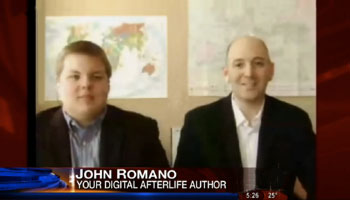
John is an award-winning interaction designer and an ardent cultural observer. His fascination: the mass adoption of digital communication tools and the change they are having on the way we interact with each other and the way we view ourselves. When he isn't contemplating on how to achieve immortality, he is either designing interactive projects at Capstrat in Raleigh, building stuff in the garage with his boy, or wandering off the beaten path on a motorcycle. Contact him at .

Posts by John Romano

Digital Identity and afterlife coverage at SXSW

Posted on 16 March 2010 by John Romano

A list of events at SXSW that all deal with digital identities and afterlife.

Virtual Interviews: A Chat With Darwin’s Ghost
#syntheticinterview
Ralph Vituccio and John Dessler
Carnegie Mellon Entertainment Technology Center
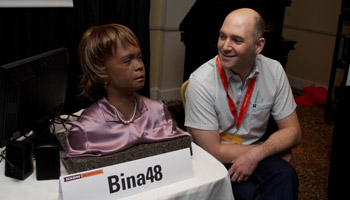
Synthetic Interview is a unique technology that allows people to have a conversation with a character or persona as if that person were present in real-time. The goal is creating immersive experiences, allowing guests to interact with a digital character from either the past, the present or the future.

People Die, Profiles Don’t
#peopledieprofilesdont
Jesse Davis with Entrustet
Talk about companies and how they deal with users deaths. What can websites do to streamline the process of handling the deceased’s wishes for their online accounts?

eSee Technologies
#eSeetech
Ian Mitchell
Augmented Reality device that may serve life loggers and average Web users alike at eseetechnologies.com.

I also saw this article that Apple has hired Richard DeVaul of AWare Technologies who is an expert in heads up technology. Can you say iSee?

What If Your Phone Had Five Senses?
#phonehad5senses
Ted Power of Google
The phone in your pocket has the sense of sight (camera), sound (microphone), touch and location. They also have sense of light, proximity, acceleration, orientation. All these senses potentially serve to describe your experiences and enrich your digital identity.

My Life, Take Two: The Right to Delete
#mylifetaketwo
Panel
Most of us have incidents in our past that we’d rather leave there – but that’s getting harder in a world teeming with tools and devices that capture our actions and record them forever. Do we have a ”right to delete” records and data about ourselves? Can we? Should we?

Have You Planned for Your Digital Afterlife?

Interview with Adel Mcalear
@DigitalLegacy

Comments (0)

What do you want to happen to your Facebook profile after you die?

Posted on 14 January 2010 by John Romano

What’s Your Preference? What do you want to happen to your Facebook profile. Should it:

  1. be turned into a memorial
  2. be archived
  3. be deleted
  4. something else?

Let us know what you think.

Comments (3)

Archive your digital identity, the afterlife

Posted on 23 November 2009 by John Romano

Once you’re dead and gone – past the time when anyone that you know is alive – will your digital identity remain? Will your future descendants be able to look at your images and videos, read your writing, and get to know what your life was like here on Earth?

Most likely, but currently there is nothing to guarantee that. We would need an institution devoted to maintaining an individual’s digital identity, kind of like a digital cemetery. But instead of cutting the grass and tending flowers, the cemetery will tend your personal data.

There are companies that are beginning to offer services like these. But will the service outlive you? The internet seems to reinvent itself every 5 years so who knows what it will look like in 50. Cemeteries are protected by law, but data is not. Un-plug the computer and the data is gone.

We wonder if this is the next manifestation in our search for immortality or just Cemetery 2.0? For now we’re not sure, but if  the idea of your digital identity outliving you appeals to you, then you need to start thinking about your online life a little differently because everything that you put online may be here for years, or centuries, after your death. Or it may be gone tomorrow.

For now, you need to make sure that there is someone to look after your data after you die. Prepare. Maybe even subscribe to a service. Either way, start thinking about it, because your digital identity will outlive you, one way or another.

Comments (0)

Orlando Sentinel

Posted on 01 September 2009 by John Romano

Etan Horowitz at the Orlando Sentinel has written two articles that mention The Digital Beyond.

The first, “What happens to your virtual world after you die?” is about the fate of online accounts after death. He talks about how people have been affected and what they can do to protect themselves.

The other is an article “How Facebook, MySpace, Gmail and other handle your accounts when you die” where Etan has written a good guide about how Facebook, MySpace, Gmail, Yahoo mail, and Windows Live mail handle death.

Cheers Etan. Spread the word.

Comments (0)

Digital Execution for the Living

Posted on 26 August 2009 by John Romano

Do lifetime Internet bans on individuals (as part of a sentence for breaking the law) amounts to “digital death”? Check out this interesting article by Andrew Moshirnia at Citizens Media Law Project about how the court is using bans as part of sentencing.

We’ve been talking about digital death (and afterlife) in context of the physical death of the individual. But the idea that the court could execute your digital identity is fascinating and potentially scary. Here we are, barely 15 years into the modern Internet, and we considering the revocation of Internet privileges.

But there are greater problems that arise here. The Internet is now breaking away from personal computers, and is finding it’s way to public spaces. It’s also found it’s way to mobile devices. So would this ban VOIP, Internet enabled iPhone apps, and Netflix? Where does it end?

I think that access to the Internet will become more of a right, than a choice. I also expect to see a lot of legislation surrounding this issue in the coming years.

Comments (1)

Social reefs

Posted on 11 August 2009 by John Romano

I have two friends, Paul and Richard. They only know each other through me. What happens to that social connection when I die?

Normally all the social connections created through me after I die may slowly decay. As Richard and Paul die, only the physical artifacts (the photos, letters, etc.) remain. 100 years from now, their relationship to me and each other may be more dead and forgotten than I am.

The creation of a social reef.

Richard and Paul are both “friends” of mine on Facebook. When I die, my digital social skeleton (my Facebook profile) will still connect them, as long as my profile is in place.

Digital social skeletons would create a social reef, a skeletal framework like the great coral reefs. Social reefs would be made of millions of social connections devoid of the life that created them. The questions is whether or not the new online skeletons will decay over time, or whether they will become a foundation for a larger social reef to form on top of them.

All I can imagine are digital archeologists a hundred years from now, with super user access, spelunking into the caves of deceased social networks. Running data mining scripts that extract data and illuminate the past.

Comments (3)

The artifacts of social interaction

Posted on 06 August 2009 by John Romano

In the physical world, interactions between people are remembered. Sometimes the interaction leaves behind physical artifacts. Letters are frequently treasured objects – remembrances of love, loss, and revolution. Photos of people long gone often become family heirlooms.

That fact that interactions help form our self identity and our bonds to other people reminds us that people are social creatures. So it shouldn’t surprise us that online social media is consuming the Web. An online analogy of an offline biological imperative seems like a natural extension for humanity.

All this online social interaction leaves behind artifacts, too. Tweets, Facebook messages, photos, videos and comment streams of all sorts.

So do these interactions belong to their creators or all the participants? If you are in your friend’s photo, is it also part of your identity? I would venture to say “yes”. But this affirmation raises some serious questions about ownership and our ideas of assets.

If virtual assets are going to be archived and permanently associated with a person, what assets should go into storage? Every picture that you take? Every picture that you are tagged in? Every picture that you talk about with our friends?

Is it possible that the interaction is the asset and that all the participants are the owners?

It seems to me that the old model of creator and creation – owner and asset may become outmoded. I see a new model of interaction and participant. But it isn’t that easy. User agreements form the only legal framework available, and they often state that service is the owner of the interaction.

Would a service that captures and archives the interaction make sense? Are the interactions out of context valuable?

Comments (2)

Digital Death is Born

Posted on 20 July 2009 by John Romano

… along with the promise of a digital after life.

The concept of “digital death” and “digital afterlife” are just beginning to enter into the public consciousness. We see a constant stream of writers, academics, and entrepreneurs that are realizing the coming importance of digital death and afterlife.

What we know
Interacting and expressing yourself online produces copius amounts of personal data that create a digital identity.

And even though physical death is inevitable, the death of your digital identity is not. This identity will survive as long as it’s data lives on. But this raises lots of questions.

digitaldeath.eu

Some thoughtful people at http://www.digitaldeath.eu have joined us in our exploration of this new frontier. Head on over to their site. Their scholarly approach reads quickly and they have some videos that address the digital beyond.

Comments (0)

Death Fail

Posted on 01 July 2009 by John Romano

The issue of digital death is getting common enough that we can now FAIL to answer the question.

http://failblog.org/2009/06/10/yahoo-answers-fail/

Comments (0)

Articles about death, assets, and digital identity

Posted on 18 May 2009 by John Romano

Two new articles popped up.

logo-npr

Death Often Brings Disputes Over Online Lives
by Yuki Noguchi

logo-cnn

New services promise online life after death
by Mallory Simon

Comments (0)

The Digital Beyond on Facebook