Tag Archive | "facebook"

Tags: , , , , , , , ,

Mourners Turn To Mobile Phones To Remember Deceased

Posted on 19 December 2011 by Evan Carroll

Mobile Phone

Photo by Johnathan Lyman

Death used to be the final disconnect from the mortal world, but that’s not quite the case anymore. From the paranormal to the touching, tales abound about technology beyond the grave. Perhaps more telling is what these stories tell us about our changing culture.

John Jacobs, 55, passed away in 2005 following a battle with pancreatic cancer, but he’s not quite out of touch with his family. The New York Post reported in 2008 that Jacobs’ wife continued to pay the 55-dollar Verizon bill keeping his mobile phone service alive and well, with no plans to shut it off.

“As long as someone is still out there who cares, I still care. My kids still care. His friends still care,” Jacobs says. “I don’t think I’ll ever shut it off.”

In an added twist, Jacobs was buried with his cell phone fully charged. Mourners were startled when the first post-mortem call arrived during the burial service. Jacob’s wife, Marian Seltzer, even had Jacobs’ headstone engraved with his phone number. Family and friends continue to leave voice messages for Jacobs, taking comfort in this facsimile of his presence.

Jacobs’ isn’t the only post-mortem account that Verizon managed. Fox News reported about Charles Whlting of Irvington, NY, who kept his wife’s voicemail active since 2005. Whlting, 80, kept the account active so that he could listen to Catherine Whlting’s voice on the outgoing message. In 2008, a change in the voicemail system brought this story to light, as Whlting thought the recording was lost. Whlting blamed Verizon saying, “Now they took her voice away.” Luckily a Verizon contractor was able to locate an archived copy of the recording and restored Catherine Whlting’s voice to the system.

For a dose of the paranormal, a UK-man believes that he’s receiving text messages from his deceased wife, who, like Jacobs, was buried with her mobile telephone.

“She always had a mobile with her,” Jacobs told The Register. ” We buried her with her phone. There have been messages with words Sadie would say but there’s no number.”

Video

QR Codes Turn Headstones Into Interactive Memorials

Living Headstone – QR Codes Turn Headstones Into Interactive Memorials

Paranormal events aside, Perhaps Seltzer and Whlting were ahead of their time. Products and online services now abound offering new ways to remember loved ones through technology. Traditional monument manufacturer Quiring Monuments launched its Living Headstone product in March. Free for new headstones and 65 dollars for existing ones, customers receive a QR code to place on the headstone and a five-year subscription to a personal Web page, complete with photos and writings in memory of the deceased. An administrator, presumably a family member, manages the Web page. Cemetery visitors with smartphones can read the QR code and visit a memorial Web page to learn more about the deceased.

Another company, Rosetta Stone (not to be confused with the foreign language software), offers NFC-enabled microchips for headstones. Similar to Quiring, Rosetta Stone directs cemetery visitors with NFC-enabled smartphones to a memorial Web page.

While the exact numbers are open for debate, many sources, including The Washington Post, report that the average lifespan of a Web page is 44-75 days. Pages owned by corporations are likely more durable, but the Web is fleeting. The challenge for any of these memorial Web pages or voicemail accounts is a digital death, when they are no longer accessible.

Video

1000Memories.com - Remember a Loved One, Together

1000Memories.com – Remember a Loved One, Together

The founders of 1000Memories, a San Francisco-based startup currently backed by 2.52 Million in funding, want to make ensure the permanence of online memorials. The service allows users to create “memory pages” for loved ones. Unlike other memorial website companies, 1000Memories has partnered with the Internet Archive to ensure accurate inclusion of its pages in the Wayback Machine. The company also published an overview of its safeguards to ensure the permanence of memory pages.

Considering the rise of specialty websites like 1000Memories and new memorial products, we’re clearly in the middle of a culture shift. Technology, once considered irreverent, is now a welcome component of the grieving process. Perhaps further evidence of this is the deluge of online services offering to help individuals secure their digital legacies by leaving a list of user names and passwords or writing emails for their heirs. A significant part of today’s culture, social networking sites also offer memorial services. Facebook, for example, allows survivors to convert profiles into a memorialized state and Twitter offers families archives of their loved ones’ public tweets.

As we continue to shift toward a completely digital culture, it’s certain that technology will play a greater role in memorials. As Chuck Palahniuk wrote in Diary: “We all die. The goal isn’t to live forever, the goal is to create something that will.” Perhaps our digital memorials will fulfill that goal.

Comments (2)

Tags: , ,

Data MYning

Posted on 11 October 2010 by Evan Carroll

In January I made a few predictions about digital afterlife trends for 2010. In that post I cited a prediction by TrendWatching.com that “profile myning” would be a crucial trend to watch in 2010. “Profile myning” is an intentional word play on profile mining, the process of extracting patterns and thus business intelligence from social profiles. I’ll quote their report again here:

With personal profiles (which are the nucleus of one’s personal brand) representing an ever-greater emotional and financial value, expect a burgeoning market for services that protect, store, and, in case of emergencies/death, arrange handing over of one’s digital estate to trusted others. – trendwatching.com

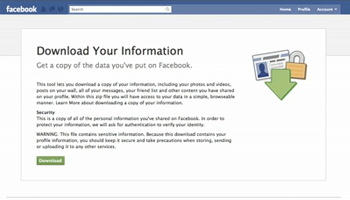
Now to recent news. Last week Facebook, in a blog post called “Giving You More Control” attributed to Mark Zuckerberg himself, announced new features. The usual privacy and functional enhancements were included, but of more interest to us here they announced a new feature that allows users to download their Facebook data. Once the feature is completely rolled out, users will be able to request a zipped file of their Facebook contributions. “Your messages, Wall posts, photos, status updates and profile information” will all be included. I don’t see the download link in my account yet, but here’s what Facebook had to say about it, including a video that demonstrates the new feature:

First, we’ve built an easy way to quickly download to your computer everything you’ve ever posted on Facebook and all your correspondences with friends: your messages, Wall posts, photos, status updates and profile information.

If you want a copy of the information you’ve put on Facebook for any reason, you can click a link and easily get a copy of all of it in a single download. To protect your information, this feature is only available after confirming your password and answering appropriate security questions. We’ll begin rolling out this feature to people later today, and you’ll find it under your account settings.

I’ve got to hand it to the folks at TrendWatching.com as this sure sounds like “profile myning” to me. I’m also reminded of Twitter’s new policy for deceased users that was announced earlier this year. It allows for your heirs to obtain an archive of your public tweets. Although I have some issues with that policy, it, like the Facebook download, is a good feature that will help secure your digital content. After all, that content will become your digital legacy.

I think it’s a good move by Facebook. But, remember that Facebook deletes status updates made by deceased users as a part of memorializing a profile. Wouldn’t it be great if Facebook would share this download with your heirs? Wouldn’t it be even better if they asked you if you wanted that to happen and who should have access? That would be an ideal situation. But for now, you can make sure your digital executor has your Facebook password and is poised to request this download as soon as possible. Time is of the essence because anyone with a link to an obituary can request that a profile be memorialized.

Comments (1)

Tags: , , ,

A legal perspective

Posted on 30 June 2009 by Evan Carroll

A recent article from Law Vibe provided some advice regarding the legal considerations for digital estate planning. The article recognized the law’s lack of precedence for digital assets and provided some insight about different types of online content like email, blogs and social networking profiles.

As we’ve discussed before, there are two issues at play: content and access. 

Content is simple. Anything that you’ve created is your intellectual property and that is governed by traditional property laws. Many sites require that you accept a terms of service document that essentially grants them ownership of your content. That’s right, you don’t legally own the contents of your Facebook profile. Most of these services allow you to cancel your account and remove the content from their servers. In February Facebook took some heat for changing their TOS document to grant them complete ownership of your content.  This was to clarify that Facebook should continue to display messages you’ve sent to other people even after you cancel your profile. Their intention was not to deny you control of your own content, despite the legal terms. As long as Facebook values their users there’s a large social control that will prevent them from doing anything nefarious with your content.  You should check the terms of service for your accounts and be certain of content ownership.

Access is a bit more complicated. Policies often prevent your survivors  from accessing your content and this was the source of several lawsuits like the one mentioned by Law Vibe.  This is where your digital executor and digital will come into play. The digital executor can help you carry out your wishes according to a document giving them passwords and instructions. It’s simple and more direct, but lacks legal standing. Law Vibe provides a good set of instructions for how to do this, but you should also check out our Digital Death Survival Guide. My only caution is that you do not list user names or passwords in your legal will. Law Vibe doesn’t mention this, but it’s important to remember that a legal will becomes a public document upon your death.

I’m pleased to see that Law Vibe is thinking about this issue. This is certainly coming to the forefront of modern law practice.

Comments (0)

Learn more about our new book, Your Digital Afterlife. Find us at SXSW Interactive.