Archive | Featured

Tags: , , , , , , , ,

Mourners Turn To Mobile Phones To Remember Deceased

Posted on 19 December 2011 by

Mobile Phone

Photo by Johnathan Lyman

Death used to be the final disconnect from the mortal world, but that’s not quite the case anymore. From the paranormal to the touching, tales abound about technology beyond the grave. Perhaps more telling is what these stories tell us about our changing culture.

John Jacobs, 55, passed away in 2005 following a battle with pancreatic cancer, but he’s not quite out of touch with his family. The New York Post reported in 2008 that Jacobs’ wife continued to pay the 55-dollar Verizon bill keeping his mobile phone service alive and well, with no plans to shut it off.

“As long as someone is still out there who cares, I still care. My kids still care. His friends still care,” Jacobs says. “I don’t think I’ll ever shut it off.”

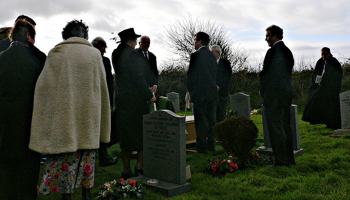
In an added twist, Jacobs was buried with his cell phone fully charged. Mourners were startled when the first post-mortem call arrived during the burial service. Jacob’s wife, Marian Seltzer, even had Jacobs’ headstone engraved with his phone number. Family and friends continue to leave voice messages for Jacobs, taking comfort in this facsimile of his presence.

Jacobs’ isn’t the only post-mortem account that Verizon managed. Fox News reported about Charles Whlting of Irvington, NY, who kept his wife’s voicemail active since 2005. Whlting, 80, kept the account active so that he could listen to Catherine Whlting’s voice on the outgoing message. In 2008, a change in the voicemail system brought this story to light, as Whlting thought the recording was lost. Whlting blamed Verizon saying, “Now they took her voice away.” Luckily a Verizon contractor was able to locate an archived copy of the recording and restored Catherine Whlting’s voice to the system.

For a dose of the paranormal, a UK-man believes that he’s receiving text messages from his deceased wife, who, like Jacobs, was buried with her mobile telephone.

“She always had a mobile with her,” Jacobs told The Register. ” We buried her with her phone. There have been messages with words Sadie would say but there’s no number.”

Video

QR Codes Turn Headstones Into Interactive Memorials

Living Headstone – QR Codes Turn Headstones Into Interactive Memorials

Paranormal events aside, Perhaps Seltzer and Whlting were ahead of their time. Products and online services now abound offering new ways to remember loved ones through technology. Traditional monument manufacturer Quiring Monuments launched its Living Headstone product in March. Free for new headstones and 65 dollars for existing ones, customers receive a QR code to place on the headstone and a five-year subscription to a personal Web page, complete with photos and writings in memory of the deceased. An administrator, presumably a family member, manages the Web page. Cemetery visitors with smartphones can read the QR code and visit a memorial Web page to learn more about the deceased.

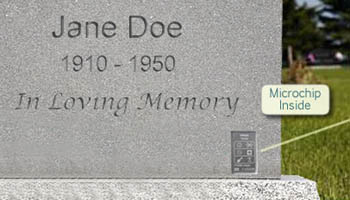
Another company, Rosetta Stone (not to be confused with the foreign language software), offers NFC-enabled microchips for headstones. Similar to Quiring, Rosetta Stone directs cemetery visitors with NFC-enabled smartphones to a memorial Web page.

While the exact numbers are open for debate, many sources, including The Washington Post, report that the average lifespan of a Web page is 44-75 days. Pages owned by corporations are likely more durable, but the Web is fleeting. The challenge for any of these memorial Web pages or voicemail accounts is a digital death, when they are no longer accessible.

Video

1000Memories.com - Remember a Loved One, Together

1000Memories.com – Remember a Loved One, Together

The founders of 1000Memories, a San Francisco-based startup currently backed by 2.52 Million in funding, want to make ensure the permanence of online memorials. The service allows users to create “memory pages” for loved ones. Unlike other memorial website companies, 1000Memories has partnered with the Internet Archive to ensure accurate inclusion of its pages in the Wayback Machine. The company also published an overview of its safeguards to ensure the permanence of memory pages.

Considering the rise of specialty websites like 1000Memories and new memorial products, we’re clearly in the middle of a culture shift. Technology, once considered irreverent, is now a welcome component of the grieving process. Perhaps further evidence of this is the deluge of online services offering to help individuals secure their digital legacies by leaving a list of user names and passwords or writing emails for their heirs. A significant part of today’s culture, social networking sites also offer memorial services. Facebook, for example, allows survivors to convert profiles into a memorialized state and Twitter offers families archives of their loved ones’ public tweets.

As we continue to shift toward a completely digital culture, it’s certain that technology will play a greater role in memorials. As Chuck Palahniuk wrote in Diary: “We all die. The goal isn’t to live forever, the goal is to create something that will.” Perhaps our digital memorials will fulfill that goal.

Comments (2)

Grieving online: social grief goes mainstream

Posted on 26 June 2011 by

With significant adoption of social networks by baby boomers and with gene x reaching middle age, we now have a broad population that is open to using the Internet as a way to grieve and remember  loved ones after death. Entrepreneurs have seen this opportunity and as a result we have seen explosive growth in the online memorials industry.

In addition to the 17 online memorial sites that we currently have on our list of digital legacy services, we are now adding ForeverMissed, Solium, People 2 Remember, StayaliveMemory-Of.com, and  Planned Departure.

We’ve seen Facebook being used as a social grieving space for several years already. Profiles of the deceased are routinely transformed into online memorials. But the memorialization process locks the profile and disables the ability to add new “friends.” As a result we’ve seen the creation of memorial “pages” on Facebook. A simple search for “R.I.P” on Facebook shows that people are creating these pages so anyone can participate.

Dedicated online memorial websites go a step further than Facebook. They create a place whose declared purpose is to connect with others and grieve socially. This eliminates the confusion that people experience when encountering death in a vibrantly social place like Facebook.

It is uncertain how sustainable all this growth is. What we are probably seeing is an initial growth explosion of a new industry. My guess is that we’ll see consolidation and drop off of companies in the coming years. But for the time being, the online memorial rush is in full swing.

Photo by Herry Lawford

Comments (1)

So what *does* happen to your digital assets after you die?

Posted on 21 December 2010 by

This is a simple question and we wish there was a simple answer. Unfortunately there isn’t a standard way that Internet users can expect service providers to handle their accounts after death. Every provider has a “terms of service” (the legalese) that governs your account. Unfortunately for consumers, no two are alike.

We cover this pretty extensively in the second half of our book, Your Digital Afterlife, but here’s a quick run down of some popular providers and what happens at each:

Facebook

Facebook covers the rights of deceased users in its privacy policy.

Your heirs can request that your account be deleted or “memorialized.” Memorialized profiles restrict profile access to confirmed friends, and allow friends and family to write on the user’s Wall in remembrance. You shouldn’t count on it staying active since anyone can request that it be memorialized by simply notifying Facebook and showing a death certificate or a news article that indicates your death.

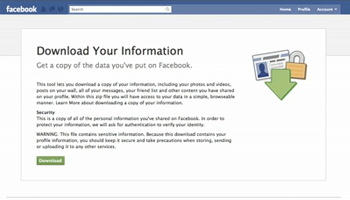
Facebook has also introduced a new feature that allows you to “Download Your Information” This tool lets you download a copy of your photos, videos, wall posts, messages, friends list and other content. The file that you download can be opened in your browser so you can navigate through your content.

Gmail

Gmail provides instructions for gaining access to deceased user’s account in its help documents. They outline the steps to gaining access, which include a death certificate, and email you have received from the account in question and proof that you have legal authority over the estate.

Twitter

Twitter addresses this issue in its help documents:

If we are notified that a Twitter user has passed away, we can remove their account or assist family members in saving a backup of their public Tweets.
Please contact us with the following information:

  1. Your full name, contact information (including email address), and your relationship to the deceased user.
  2. The username of the Twitter account, or a link to the profile page of the Twitter account.
  3. A link to a public obituary or news article.

Twitter is unique in that they offer survivors an archive of the user’s public Tweets. That’s actually very helpful as it’s often difficult to archive a Twitter account yourself.

Yahoo

Yahoo (which owns services like Flickr and Delicious) includes the following paragraph in its terms:

No Right of Survivorship and Non-Transferability. You agree that your Yahoo! account is non-transferable and any rights to your Yahoo! ID or contents within your account terminate upon your death. Upon receipt of a copy of a death certificate, your account may be terminated and all contents therein permanently deleted.

Yahoo takes a harsh stance on death, but the good news is that they will not take this action without the receipt of a death certificate. It’s possible for you to ask your digital executor to archive your Yahoo account contents before presenting Yahoo with a death certificate.

YouTube

YouTube also lists their policy for deceased users in its help documents.

If an individual has passed away and you need access to the content of his or her YouTube account, please fax or mail us the following information:

  1. Your full name and contact information, including a verifiable email address.
  2. The YouTube account name of the individual who passed away.
  3. A copy of the death certificate of the deceased.
  4. A copy of the document that gives you Power of Attorney over the YouTube account.
  5. If you are the parent of the individual, please send us a copy of the Birth Certificate if the YouTube account owner was under the age of 18. In this case, Power of Attorney is not required.

Comments (17)

Virtual Immortality: now available at virtualeternity.com

Posted on 07 November 2010 by

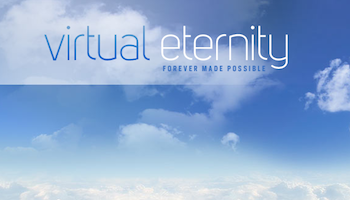
A new service has launched called Virtual Eternity that promises to create an “intelligent” avatar that can live on after you die. The avatar would look like you, sound like you, and respond to questions just like you do. And it could live on indefinitely after you are gone.

The site, virtualeternity.com, allows you to upload a photo of yourself. Immediately you begin to see your avatar take life. Their application makes your photo come alive. Your photo blinks and your mouth opens and closes as it talks. The head even bobs around naturally giving it an immediately life-life appearance.

So how does it work?

You begin by training it. You answer personality tests. You teach it to answer in the same way that you do. You also upload photos that your future avatar can talk about. You can even make a voice profile so that it talks in your voice.

Once it’s trained, it can answer questions that are typed into a text field. Now, it isn’t perfect. In fact, the makers say that it’s still in beta. It fails on many questions, but it answers some correctly. And you can assume that the more data that you give it the more that it’ll know about you. You can also assume that with time, effort and increased computing power, these avatars could get pretty high fidelity.

This is an amazing platform for knowing people from the past, whether they are famous people or your grandparent. And while its current functionality needs some work, the potential is here to offer people something that is really unprecedented and something that we have never seen before, except in science fiction.

Comments (0)

Tags: , ,

Data MYning

Posted on 11 October 2010 by

In January I made a few predictions about digital afterlife trends for 2010. In that post I cited a prediction by TrendWatching.com that “profile myning” would be a crucial trend to watch in 2010. “Profile myning” is an intentional word play on profile mining, the process of extracting patterns and thus business intelligence from social profiles. I’ll quote their report again here:

With personal profiles (which are the nucleus of one’s personal brand) representing an ever-greater emotional and financial value, expect a burgeoning market for services that protect, store, and, in case of emergencies/death, arrange handing over of one’s digital estate to trusted others. – trendwatching.com

Now to recent news. Last week Facebook, in a blog post called “Giving You More Control” attributed to Mark Zuckerberg himself, announced new features. The usual privacy and functional enhancements were included, but of more interest to us here they announced a new feature that allows users to download their Facebook data. Once the feature is completely rolled out, users will be able to request a zipped file of their Facebook contributions. “Your messages, Wall posts, photos, status updates and profile information” will all be included. I don’t see the download link in my account yet, but here’s what Facebook had to say about it, including a video that demonstrates the new feature:

First, we’ve built an easy way to quickly download to your computer everything you’ve ever posted on Facebook and all your correspondences with friends: your messages, Wall posts, photos, status updates and profile information.

If you want a copy of the information you’ve put on Facebook for any reason, you can click a link and easily get a copy of all of it in a single download. To protect your information, this feature is only available after confirming your password and answering appropriate security questions. We’ll begin rolling out this feature to people later today, and you’ll find it under your account settings.

I’ve got to hand it to the folks at TrendWatching.com as this sure sounds like “profile myning” to me. I’m also reminded of Twitter’s new policy for deceased users that was announced earlier this year. It allows for your heirs to obtain an archive of your public tweets. Although I have some issues with that policy, it, like the Facebook download, is a good feature that will help secure your digital content. After all, that content will become your digital legacy.

I think it’s a good move by Facebook. But, remember that Facebook deletes status updates made by deceased users as a part of memorializing a profile. Wouldn’t it be great if Facebook would share this download with your heirs? Wouldn’t it be even better if they asked you if you wanted that to happen and who should have access? That would be an ideal situation. But for now, you can make sure your digital executor has your Facebook password and is poised to request this download as soon as possible. Time is of the essence because anyone with a link to an obituary can request that a profile be memorialized.

Comments (1)

New Services Comparison Chart

Posted on 07 August 2010 by

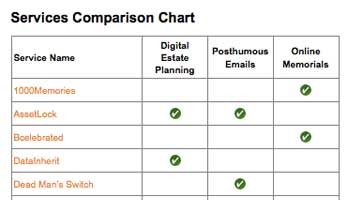
The Digital Beyond has added a comparison chart to their Digital Death Services List. Visitors to the site can now scan down our handy list and see at a glance if a service offers:

  • Digital Estate Planning
  • Posthumous Emails
  • Online Memorials

“We wanted to provide a chart to help make finding a service easier.” said Evan Carroll. “The list of companies offering services in this space is growing at such a rapid pace. We simply needed something to tell them apart. Oh, and there’s more to come. Stay tuned.”

Comments (0)

Cemeteries Going Digital

Posted on 21 June 2010 by

We are beginning to see the digitization of cemeteries. Personal Rosetta Stone is a company that sells a addition to headstones that connects mobile users in the cemetery to digital archives on the Web.

This connection between digital archives and headstones provides the missing link between the final physical remains of a human and a digital record of their life. It is a logical enhancement of the traditional cemetery experience and bereavement process. It also creates interesting possibilities for people researching their ancestors.

http://www.personalrosettastone.com

Expect to see more products that digitally enhance death in the coming years.

Comments (0)

Tags: , ,

Digital Death Day: Good People

Posted on 22 May 2010 by

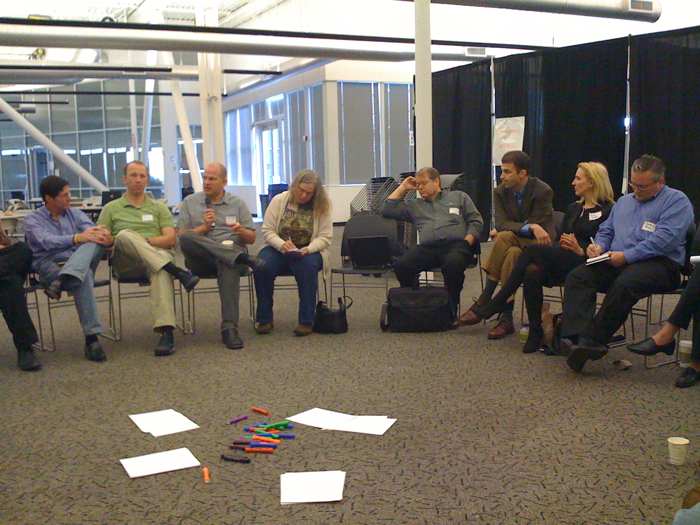
On Thursday, I had the pleasure of attending the first Digital Death Day in Mountain View, CA. For those of you keeping track, that’s a long way from NC, but the trip was well worth it. I left refueled with ideas, inspiration and connections. In this post, I’m going to cover all of the great folks I met. I also recorded podcasts with several of these folks and will share those in the next few days. You can also expect a compilation of everyone’s session notes, which I will share when they become available.

One of the unconference principles states something like “the people who come are the right people to be there.” In this case, I couldn’t agree more. We had a very diverse group: authors, researchers, technologists, funeral directors, estate planners/attorneys, and entrepreneurs. Some quick notes about the people I met…

It was a pleasure to finally meet Jeremy Toeman and his business partner Adam Burg from Legacy Locker. They’re both good guys and share a spirit of cooperation, not necessarily competition. Speaking of competition, it was good to see Nate Lustig from Entrustet again. Both Legacy Locker and Entrustet (along with DataInherit who couldn’t send a representative) were sponsors of the event.

I also met Sam Beal, founder of online-legacy.com. Sam is helping older individuals record their family stories in digital form. I was especially impressed by his telephone service that allows non-Internet users to phone in their stories. They are then preserved, like a voicemail message, for their family. The oral tradition preserved digitally—what a great idea.

Stacey Pitsillides, PhD student and creator of digitaldeath.eu, joined us from London. I’ve followed her work for some months now and I was pleased to meet her. She also shared some great videos with the group and is going to lend her design talents to the group in the future.

Some professions are slow to change, and with digital death we deal with at least two of them: funeral directors and attorneys. We had both in attendance at Digital Death Day. I was pleased to meet Nathan Dosch (www.digitalestateplanning.com) and Ryan Thogmartin (www.connectingdirectors.com) who are leading the digital charge in both of these industries. Kudos to both of them.

I also want to mention Dazza Greenwood, executive director of the eCitizen Foundation, which addresses legal and policy issues for tomorrow’s Internet systems. I’m personally excited to see a policy leader in the group and I’m sure Dazza and the Foundation will help us raise awareness and create policies for dealing with death on the Internet.

Of course, I also have to recognize Kaliya Hamlin and her team for coordinating the event. Having everyone in the same room was exactly what our community needed to move forward.

There were many others who contributed great ideas—too many to name. Thanks to everyone for the great ideas. I’ll devote a future post to the new ideas that came out of the event, but for now I’ll say that the event was an overwhelming success and I look forward to Digital Death Day 2011. (I’ve actually signed on to help coordinate the next event.) It’s an exciting time for the Digital Death community. Onward!

Comments (2)

Evan Carroll speaks at Ignite Raleigh

Posted on 27 April 2010 by

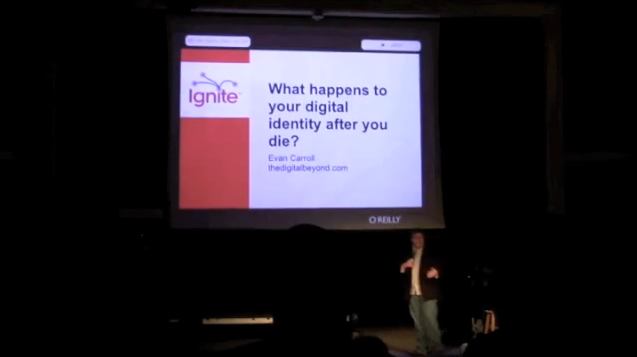
This must be video week at The Digital Beyond. The kind folks at Ignite Raleigh posted the video from my talk, What happens to your digital identity after you die? It’s a nice introduction to the digital afterlife and explains why you should care. Enjoy.

Comments (1)

Digital Afterlife Events

Posted on 27 March 2010 by

Perhaps a testament to the growing awareness of digital afterlife issues, a number of events have sprung up recently ostensibly focused on the topic.  Here are the ones that I have learned about.  Let me know if you have one that isn’t listed here.

HCI at the End of Life
April 10th, 2010
Workshop at CHI 2010 restricted to those who submitted position papers. Primarily an academic audience.
Cost: $175 plus variable costs for CHI.

Afterlife & Death in a Digital Age
April 17th, 2010
One day seminar at the National University of Singapore. Again, a primarily academic audience.
Cost: free

Digital Death Day
May 20th, 2010
This event is a one-day un-conference co-located with the 10th Internet Identity Conference in Mountain View, CA. It’s audience seems to be primarily professional.
Cost: $75

While I have some academic pursuits, the exclusivity of the CHI workshop and the distance required to visit Singapore will keep me away. I’m seriously considering Digital Death Day. It looks to be the the most relevant and accessible to me.

Comments (0)

Learn more about our new book, Your Digital Afterlife. Find us at SXSW Interactive.