Archive | Featured

Stages of the Digital Afterlife

Posted on 24 August 2009 by Evan Carroll

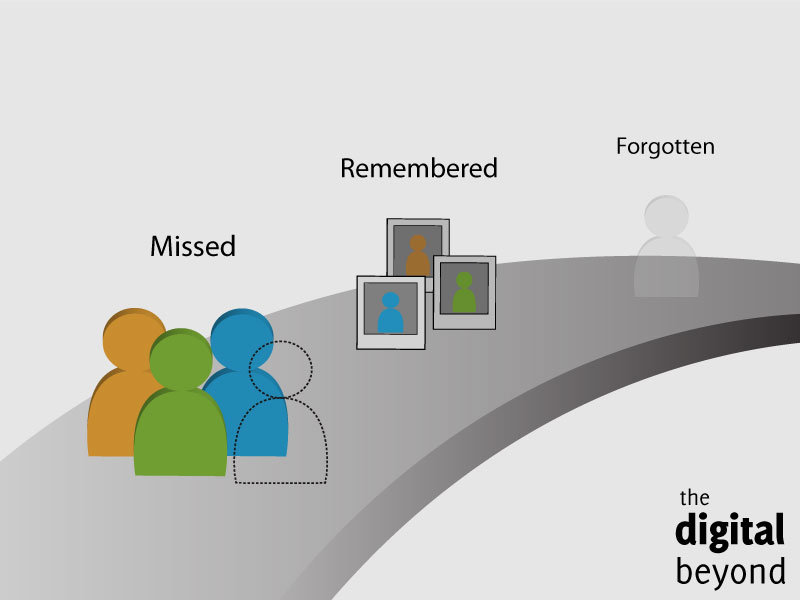
Graphic showing three stages

When researching the various services that deal with the digital afterlife, a certain pattern started to emerge.  I call this pattern the three stages of the digital afterlife: missed, remembered, forgotten.  I’ll address each in that order, naturally.

Missed

This is the stage that occurs right after death.  You’ve left a void and your survivors need to step in and handle your final affairs.  Things like closing accounts and distributing assets.  Online services exist that allow you to share vital information that your survivors will need and send final messages to them.

Remembered

Once your affairs are in order, your survivors will remember you.  Tangible items like photographs and your headstone will help them do so.  This stage lasts from the time your affairs are in order until those who knew you have also passed.  A few online services help you or your survivors create an online memorial, but there are much fewer than those which address the first stage.

Forgotten

At this point, your identity, both online and offline has passed.  Nobody remembers you first hand and what remains of your existence is a relic of a former time.  Online content lacks context, is stored in legacy formats and hasn’t been curated in years.  As far as I’m aware, there are no services addressing this stage.  This is where the real potential exists in this industry.  Imagine being able to examine the online content of your ancestors and know who they were and what they thought.  I’m not sure how this will work, but we’re here to talk about it.

Comments (10)

Social reefs

Posted on 11 August 2009 by John Romano

I have two friends, Paul and Richard. They only know each other through me. What happens to that social connection when I die?

Normally all the social connections created through me after I die may slowly decay. As Richard and Paul die, only the physical artifacts (the photos, letters, etc.) remain. 100 years from now, their relationship to me and each other may be more dead and forgotten than I am.

The creation of a social reef.

Richard and Paul are both “friends” of mine on Facebook. When I die, my digital social skeleton (my Facebook profile) will still connect them, as long as my profile is in place.

Digital social skeletons would create a social reef, a skeletal framework like the great coral reefs. Social reefs would be made of millions of social connections devoid of the life that created them. The questions is whether or not the new online skeletons will decay over time, or whether they will become a foundation for a larger social reef to form on top of them.

All I can imagine are digital archeologists a hundred years from now, with super user access, spelunking into the caves of deceased social networks. Running data mining scripts that extract data and illuminate the past.

Comments (3)

The artifacts of social interaction

Posted on 06 August 2009 by John Romano

In the physical world, interactions between people are remembered. Sometimes the interaction leaves behind physical artifacts. Letters are frequently treasured objects – remembrances of love, loss, and revolution. Photos of people long gone often become family heirlooms.

That fact that interactions help form our self identity and our bonds to other people reminds us that people are social creatures. So it shouldn’t surprise us that online social media is consuming the Web. An online analogy of an offline biological imperative seems like a natural extension for humanity.

All this online social interaction leaves behind artifacts, too. Tweets, Facebook messages, photos, videos and comment streams of all sorts.

So do these interactions belong to their creators or all the participants? If you are in your friend’s photo, is it also part of your identity? I would venture to say “yes”. But this affirmation raises some serious questions about ownership and our ideas of assets.

If virtual assets are going to be archived and permanently associated with a person, what assets should go into storage? Every picture that you take? Every picture that you are tagged in? Every picture that you talk about with our friends?

Is it possible that the interaction is the asset and that all the participants are the owners?

It seems to me that the old model of creator and creation – owner and asset may become outmoded. I see a new model of interaction and participant. But it isn’t that easy. User agreements form the only legal framework available, and they often state that service is the owner of the interaction.

Would a service that captures and archives the interaction make sense? Are the interactions out of context valuable?

Comments (2)

Digital Death is Born

Posted on 20 July 2009 by John Romano

… along with the promise of a digital after life.

The concept of “digital death” and “digital afterlife” are just beginning to enter into the public consciousness. We see a constant stream of writers, academics, and entrepreneurs that are realizing the coming importance of digital death and afterlife.

What we know
Interacting and expressing yourself online produces copius amounts of personal data that create a digital identity.

And even though physical death is inevitable, the death of your digital identity is not. This identity will survive as long as it’s data lives on. But this raises lots of questions.

digitaldeath.eu

Some thoughtful people at http://www.digitaldeath.eu have joined us in our exploration of this new frontier. Head on over to their site. Their scholarly approach reads quickly and they have some videos that address the digital beyond.

Comments (0)

Selecting a Digital Executor

Posted on 16 July 2009 by Evan Carroll

Tombstone with text: Please Delete My Facebook

With all of the conversation surrounding the digital afterlife, one thing is certain: you can’t deal with it by yourself.  You need a person or a service to help you. Services are popping up left and right, just check our (hopefully) comprehensive list. Still, for some things, you really need someone to help you out.  We (among others) have been calling this person a digital executor: a person whom you designate to execute your digital estate.

So, what makes a good digital executor?  As I see it, there are three critical components: trust, distance and capability.  I’ll address them in that order.

Trust

Seems pretty simple, right? In fact, it is.  You need to select someone who will respect your wishes and faithfully carry out your digital will. I don’t think there’s any more to say here.

Distance

Your executor needs to be close enough to you that you can trust them (see above), but needs to be somewhat distanced from you for a couple of reasons.  If you choose someone like your spouse or significant other there’s a greater chance that they will pass at the same time you do.  Then, of course, your digital will would not be carried out, unless you had others in place as well. It’s also important to have a person that will carry out your will without hesitation.  Those close to you may have trouble with deleting files or profiles (should that be your wish) in the name of preserving  your memory.

Capability

Finally, you should find someone who is up to the task and there are a few dimensions of this.  First, they should have access to your information.  However you choose to store you authentication information and wishes, they should be capable of accessing it.  Second, they should have the appropriate technical savvy.  Want your Facebook account deleted? You might want to choose someone who has a Facebook account.  Enough said.  Finally, they need to outlive you.  This goes back to distance, but you should think about age too.  When you’re young, someone from your own generation is likely suitable, but as you get older someone from the next generation may be more appropriate.

I’m sure there’s other considerations given your unique situation, but it’s my hope that this list will give you some helpful tips to get started.

Comments (0)

Tags: , ,

Twitter device confirms you are alive

Posted on 28 June 2009 by Evan Carroll

Seen today on CrunchGear and Gizmodo, this Japanese-developed device sends Tweets about your heartbeat. Despite scaring your relatives when Twitter is down, this device could lead the way for a “is ___ dead” service with a yes/no/unsure API. While this adds some biological fact to confirming one’s death, there’s several kinks like hospitalization or disconnected monitors that would introduce unreliability.

From the translated promotional video:

“Now I can die and post this info to Twitter. That’s what I call a revolution!”

Twitter Device

Twitter Heartbeat Device

Comments (1)

SXSW Digital Death Wrap Up

Posted on 22 March 2009 by John Romano

Thanks to all the attendees at the SXSW festival who came out for our core conversation “Who Will Check My Email After I Die.” We had a great time and a great conversation.

We think it is a conversation that will be the center of a lot more attention in the years to come.We hope to host a panel next year where we have an archivist, archeologist/sociologist, a lawyer, and a person from the business community. Some representation from the social networks and from Google would be great too.

For me the highlight of the conversation was when we discussed products that allow you to release content (email, videos, photos) after you die. We were talking about other possible triggers that could release content. The birth of a child. Graduation. Marriage.

This idea blew my mind. The idea that you could start conversations and communicate with loved ones years after your death is a spectacular idea. @qthrul asked does “Afterlife = cron job?”

What were the things that made you go “hmmm”?

Comments (0)

The Digital Beyond on Facebook