Do lifetime Internet bans on individuals (as part of a sentence for breaking the law) amounts to “digital death”? Check out this interesting article by Andrew Moshirnia at Citizens Media Law Project about how the court is using bans as part of sentencing.
We’ve been talking about digital death (and afterlife) in context of the physical death of the individual. But the idea that the court could execute your digital identity is fascinating and potentially scary. Here we are, barely 15 years into the modern Internet, and we considering the revocation of Internet privileges.
But there are greater problems that arise here. The Internet is now breaking away from personal computers, and is finding it’s way to public spaces. It’s also found it’s way to mobile devices. So would this ban VOIP, Internet enabled iPhone apps, and Netflix? Where does it end?
I think that access to the Internet will become more of a right, than a choice. I also expect to see a lot of legislation surrounding this issue in the coming years.
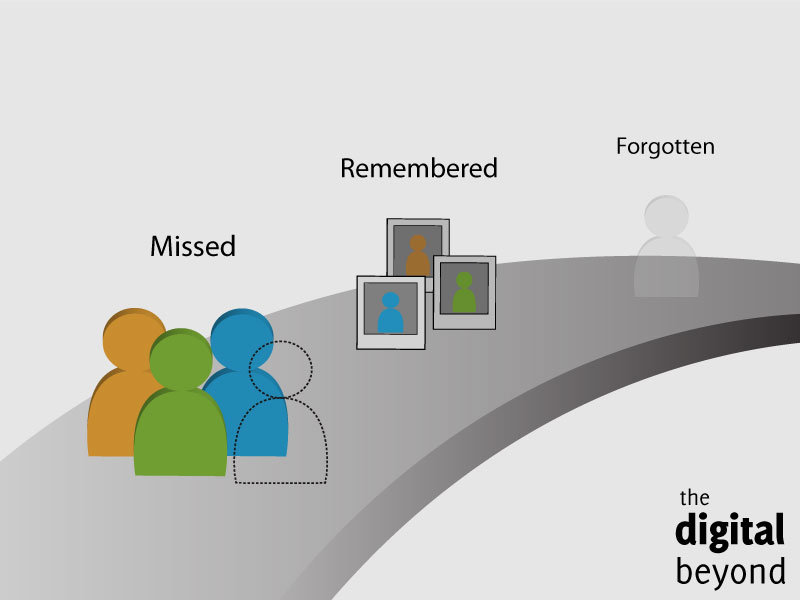
When researching the various services that deal with the digital afterlife, a certain pattern started to emerge. I call this pattern the three stages of the digital afterlife: missed, remembered, forgotten. I’ll address each in that order, naturally.
Missed
This is the stage that occurs right after death. You’ve left a void and your survivors need to step in and handle your final affairs. Things like closing accounts and distributing assets. Online services exist that allow you to share vital information that your survivors will need and send final messages to them.
Remembered
Once your affairs are in order, your survivors will remember you. Tangible items like photographs and your headstone will help them do so. This stage lasts from the time your affairs are in order until those who knew you have also passed. A few online services help you or your survivors create an online memorial, but there are much fewer than those which address the first stage.
Forgotten
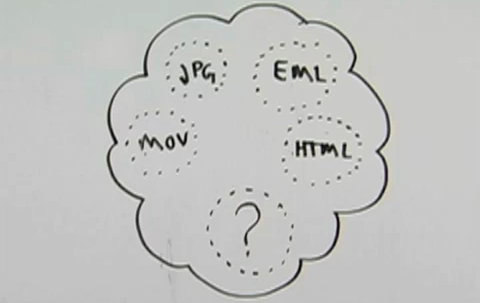
At this point, your identity, both online and offline has passed. Nobody remembers you first hand and what remains of your existence is a relic of a former time. Online content lacks context, is stored in legacy formats and hasn’t been curated in years. As far as I’m aware, there are no services addressing this stage. This is where the real potential exists in this industry. Imagine being able to examine the online content of your ancestors and know who they were and what they thought. I’m not sure how this will work, but we’re here to talk about it.
What happens to your digital identity after you die? This video explains the issues of death and the opportunities brought about by technology and the Internet.
I have two friends, Paul and Richard. They only know each other through me. What happens to that social connection when I die?
Normally all the social connections created through me after I die may slowly decay. As Richard and Paul die, only the physical artifacts (the photos, letters, etc.) remain. 100 years from now, their relationship to me and each other may be more dead and forgotten than I am.
The creation of a social reef.
Richard and Paul are both “friends” of mine on Facebook. When I die, my digital social skeleton (my Facebook profile) will still connect them, as long as my profile is in place.
Digital social skeletons would create a social reef, a skeletal framework like the great coral reefs. Social reefs would be made of millions of social connections devoid of the life that created them. The questions is whether or not the new online skeletons will decay over time, or whether they will become a foundation for a larger social reef to form on top of them.
All I can imagine are digital archeologists a hundred years from now, with super user access, spelunking into the caves of deceased social networks. Running data mining scripts that extract data and illuminate the past.
In the physical world, interactions between people are remembered. Sometimes the interaction leaves behind physical artifacts. Letters are frequently treasured objects – remembrances of love, loss, and revolution. Photos of people long gone often become family heirlooms.
That fact that interactions help form our self identity and our bonds to other people reminds us that people are social creatures. So it shouldn’t surprise us that online social media is consuming the Web. An online analogy of an offline biological imperative seems like a natural extension for humanity.
All this online social interaction leaves behind artifacts, too. Tweets, Facebook messages, photos, videos and comment streams of all sorts.
So do these interactions belong to their creators or all the participants? If you are in your friend’s photo, is it also part of your identity? I would venture to say “yes”. But this affirmation raises some serious questions about ownership and our ideas of assets.
If virtual assets are going to be archived and permanently associated with a person, what assets should go into storage? Every picture that you take? Every picture that you are tagged in? Every picture that you talk about with our friends?
Is it possible that the interaction is the asset and that all the participants are the owners?
It seems to me that the old model of creator and creation – owner and asset may become outmoded. I see a new model of interaction and participant. But it isn’t that easy. User agreements form the only legal framework available, and they often state that service is the owner of the interaction.
Would a service that captures and archives the interaction make sense? Are the interactions out of context valuable?