Posted on 27 November 2009 by Evan Carroll
With the recent increase in visits to this site, I’ve been explaining its purpose more often in conversation with others. Generally speaking those who are technically-minded understand the issues with digital death and are surprised that they hadn’t considered them before. That epiphany is my favorite moment in any conversation about this. But I’ve talked with more people recently who don’t get it. One person today told me this “I think of it just like I think of what happens to my body: I won’t be here to care.” I may have paraphrased that inadvertently due to my memory, but I must say that I completely disagree with that sentiment.
Digital assets are rapidly replacing tangible ones. Consider family photos. These days they are more likely to be digital from the time they’re taken. Archivists refer to this as a “born-digital” asset. These born-digital assets, in this case digital photographs, are family heirlooms, a vital part of your identity. Passing these heirlooms to the next generation is not just a luxury, it’s an integral part of identity preservation. We’ve been doing this for ages. By passing an object of our identity along, we can leave a story or memory behind. It’s important to know how your survivors will obtain your born-digital assets, because they won’t find a drawer of printed photos in your residence, they’ll have to go looking on your computer or in the cloud.
The issue of identity preservation is just one of many others. What about access to vital information like emails or web hosting accounts? How about the necessity to delete some content, to hide things you wouldn’t want others to know? I could probably think of a million other reasons why this issue is important, but the bottom line is that the more digital assets you have (and it’s growing, trust me) the problem will only grow.
To that thought, I’d like to hear some of the reasons you’re considering the digital afterlife. Comment it up, folks.
Posted on 23 November 2009 by John Romano
Once you’re dead and gone – past the time when anyone that you know is alive – will your digital identity remain? Will your future descendants be able to look at your images and videos, read your writing, and get to know what your life was like here on Earth?
Most likely, but currently there is nothing to guarantee that. We would need an institution devoted to maintaining an individual’s digital identity, kind of like a digital cemetery. But instead of cutting the grass and tending flowers, the cemetery will tend your personal data.
There are companies that are beginning to offer services like these. But will the service outlive you? The internet seems to reinvent itself every 5 years so who knows what it will look like in 50. Cemeteries are protected by law, but data is not. Un-plug the computer and the data is gone.
We wonder if this is the next manifestation in our search for immortality or just Cemetery 2.0? For now we’re not sure, but if the idea of your digital identity outliving you appeals to you, then you need to start thinking about your online life a little differently because everything that you put online may be here for years, or centuries, after your death. Or it may be gone tomorrow.
For now, you need to make sure that there is someone to look after your data after you die. Prepare. Maybe even subscribe to a service. Either way, start thinking about it, because your digital identity will outlive you, one way or another.
Posted on 20 November 2009 by Evan Carroll
Many of you likely want to know what you can do to plan for your own digital afterlife. It’s something important to think about and we’re glad you’re here to get started.
Step one: Define your assets
A good first step is to inventory your online assets. Going through this process will not only result in a working list, the process will help you understand exactly how many assets you have. You’ll find more than you thought of beforehand.
Step two: Decide your wishes
Now that you have a list, go through it and decide what you would like to happen to each asset. Maybe you want it deleted, maybe you want it archived or perhaps you want it left alone. In any case, decide what you want to happen. It might also be a good idea to check the terms of service for any Web site for which you have a log in to see if they’ve already made some decisions for you.
Step three: Choose one or more executors
You won’t be around to push the buttons, so you’ll need a survivor to do it for you. Asking a trusted friend or relative to help is essential to having your wishes honored. Think about who is knowledgeable enough to help you out with your assets. Perhaps one person comes to mind or perhaps you want to divide tasks up amongst several people. We have more information about selecting executors here.
Step four: Document your wishes
Finally document your wishes and put them in a place that’s accessible by your executor(s). There are many online services that will help you out with this part. You may be able to do this yourself using a safe-deposit box or other security mechanism, but a service might make it easier or more secure for you. It’s important to think about how to best secure your information and passwords. Whatever you do, don’t list them in your will as that will become public record.
Of course, you’ll want to make sure you make these decisions carefully and with the input of your relatives. If you have any concerns it’s never a bad idea to consult your attorney.
Posted on 20 November 2009 by Evan Carroll
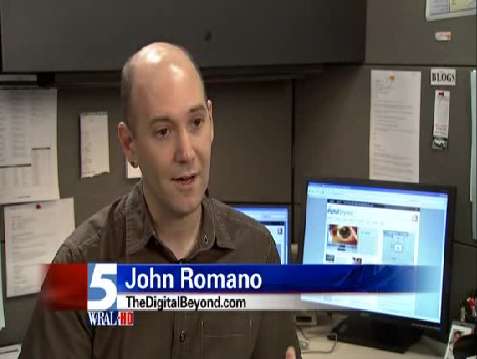
John Romano and Evan Carroll, creators of The Digital Beyond, appeared on WRAL in Raleigh, NC giving some helpful advice about preparing for the digital afterlife. You can read the full story online at www.wral.com.
We also have a checklist to help you plan for your digital afterlife.
.