Archive | August, 2010

Interview with Dazza Greenwood of the eCitizen Foundation

Posted on 16 August 2010 by

We interviewed Dazza Greenwood, executive director of the eCitizen Foundation at Digital Death Day 2010. Dazza was previously a government attorney and lecturer and researcher of digital identity at the MIT Media Lab. This is another of several interviews with digital afterlife leaders recoded at the event. You can listen below or read the transcript.

Interview with Dazza Greenwood

Evan: Hi, Evan Carroll here with The Digital Beyond and I am at Digital Death Day. And there’s a lot of ambient noise in the background. We will try to forget about that and keep going. But I am here with Dazza Greenwood, he is the Executive Director of the eCitizen Foundation. Like I said, we are here at Digital Death Day and we were just in a very interesting discussion about the idea of preserving all of your data for an indefinite amount of time. So would you start by telling me what the eCitizen Foundation does?

Dazza: Sure, yes. Thanks, Evan. It’s good to be here with you. First of all, the eCitizen Foundation is a non profit that exists to work with the public and private sector to architect, design, help deploy information architectures for really the benefit of ordinary people—regular e-citizens, citizens of the world now doing their every day things in cyberspace increasingly. Their government is e-government, their commerce is e-commerce, their learning is e-learning and so and on down the line. Their health is increasingly really happening through information systems with electronic medical records and online diagnostics and electronic patient identities that are giving consent. And so part of our interest here is as we talk with so many stakeholders about digital identity of the citizens and the privacy and personalization and right to responsibilities around that. A big missing piece is the identity transition of death of those citizens, the inevitable life cycle event when the citizen dies and the identity, the digital identities, the digital assets we are calling them here, their stuff in cyber space continues in some way. There is some state change that is not yet reflected or supported really in our systems designs and our services and our law and our business models, even in our thinking to a great extent. We feel that there is a missing piece and we are here to become more educated and to engage in dialogues and then to vector some of that of that thinking back into the policy making and the technology making circles that we participate in when we talk about the identity and the digital life of the citizens.

Evan: Very good, it’s fascinating work. To connect back to a session we were just in, we were discussing how there is one perspective that says that we should keep all the data we create. And perhaps leave that to the future generations to sort through it and make value out of. Versus another perspective where it’s actually good to delete things and to actually curate your own identity. What’s your take on that?

Dazza: My take is yes. That’s true, both of those things, although seemingly, cosmetically on the surface contradictory. They are both important principles and somehow must be accommodated in the information architectures of the future that are emerging now. And we need to do some more careful design work to make sure that we are accommodating adequately these somewhat competing goals. We know that privacy is important during life and it is no less important after death. In some ways it could be all the more of a cruel twist, almost a desperation of the person’s identity to have some of the data disclosed, or taken out of context or used in an abusive way after death than would be even during their life for sociological or even religious reasons. We think that what you need to have really is a way to create and preserve and harvest the vast amount of data that we are creating in all of our appliances and transportation and all the activities of our life, in a way that preserves people’s privacy and security. And there are ways to do that. Also there has to be traditional personal layer under the more narrow ownership and control of individual people, individual citizens, where they can, in a curated way, select just those artifacts that are important within a constellation of meaning and a suite of data and an identity, if you will, and pass that forward almost like a family album. Or a deliberate persona that they are constructing and projecting during their life and frankly after that as well. Now there’s people that have fought long and hard about how to double blind data, how to disaggregate personal identifiable information from maybe population trends. Four percent of this population ate cheese sandwich on Wednesday, for example. Maybe individually that may either be irrelevant and you wouldn’t curate it or on the other side of the spectrum it may be so relevant or so sensitive, because of the religious taboo against eating cheese with your meat on that day or something, you would never want to record it and attach to your name to it. And yet societally from anthropological perspective, we may want to preserve that data. In fact, I would say that we would certainly want to preserve all the data and we will want to allow for curated, very private and sensitive ways to correlate individual citizens. How we square that circle, how we balance that on the tight rope. that is the national dialogue that we want to help spark and make sure can emerge. So that we can intelligently, deliberately design the information architecture of our civilizations that will express that balance in a just and in a fair way.

Evan: Absolutely, we arrived at the notion in this session that Dazza is reflecting on is that the value is both temporal and situational. So it depends upon what type of information you are seeking, in the anthropological example you gave and the temporal so what is the value to me today may not be valuable to someone in the future, but maybe even more valuable to some one in the future. It’s also important, at least in the conversation I had after this session, is what I see as valuable today is valuable in and of itself. So there is a sense of meta value that we are establishing that is fascinating. So, one final question. We are about halfway through the Digital Death Day workshop here. What would you say is your biggest take away so far?

Dazza: The major thing I have seen and acknowledged is validation that what we’ve been talking about in the eCitizen Foundation. The questions that we’ve been increasingly asked about, questions around deaths of people, what it means to their civic id, their digital identity have validations. These are timely questions and that there is a respectful and kind of professionally appropriate manner to discuss them. That the questions arise across different disciplines. We’ve seen people from many different disciplines here. And that the approach from little corner of the world that the eCitizen occupies, which is a design and architectural approach according to some of the softer types of requirements that comes from societal or legal premises is relevant in this area. It’s really validated our interest in the area. And the second thing is, in a very practical way it’s created value. Some of the companies that provide services in this area have indicated that they would like to come and participate in future event in Washington D.C. that eCitizen would be convene where we would talk from a policy and more from a legal perspective about some of the types of reforms. Maybe some pilot projects and some potential tweaks to standards that may be necessary as we continue the dialogue. So we got validation and we were able to meet birds of a feather who wanted to work together. And I would call it a very good start on this and it’s a new beginning.

Evan: Absolutely. You are absolutely right. There was a great gathering of different perspectives here today. And a gathering that I want to see continued in the future because this is a very important conversation. Well, thank you for taking your time to join me and our listeners at The Digital Beyond and we look forward to speaking with you in the future.

Dazza: It was a pleasure and I will be sure to start pointing to your blog.

Evan: Very good. Thank you.

Comments (0)

Tags: , ,

SXSW 2011: You’re dead. Your data isn’t. What happens now?

Posted on 11 August 2010 by

Following our top-rated core conversation in 2010, Become Immortal: Understanding the Digital Afterlife, we’re ramping up for SXSW 2011. But to get there, we need your help. The first round of the panel selection process is underway and that means it’s time to vote for your favorite ideas in the Panel Picker.

You should give us a thumbs up. We’d really appreciate it. All you have to do is create an account and click the thumbs up icon on our page.

Here’s some more information about our idea and the awesome set of panelists we have lined up.

Description

The Web has changed your life, your death and what you leave behind. Your heirlooms like photos, videos and letters are now stored in digital form and—in many cases—on servers that you don’t own like those of Flickr, YouTube and Gmail. What should happen to your “legacy” data? With over 285,000 Facebook users set to die this year, you really should think about it.

The Internet generation is coming of age and this issue is only growing. We have to respond with new legal frameworks and standards to support this change. The good news is that entrepreneurs, attorneys, archivists and scholars are already working on solutions. Join us to learn what happens to your digital life after you die and what’s being done to give you a say in it.

Key Questions

  1. How significant is a lifetime of data and how should it be preserved/archived/deleted after its creator is gone? Can we keep it forever?
  2. How is the law changing to support the legal transferability of digital assets? What can I do to secure them today?
  3. How is the business of death changing to support digital assets? What companies and solutions are emerging to deal with this?
  4. Today, online identity is designed for short term use, what types of information architectures and policy structures would support identity throughout and after our lives?
  5. If the social Web is redefining the way we interact with each other, what role will it play in the way we grieve together?

Comments (0)

Twitter adopts policy for deceased users

Posted on 09 August 2010 by

Twitter recently announced its policy for handling the accounts of deceased users. Before I get into my thoughts about the policy, Kudos to them. They’re ahead of the many social websites that do not have any stated policy.

It’s also worth stating that there’s a pattern here. Facebook created the memorialized profile around the same time that they began to suggest friends or ask you to reconnect with inactive users. When users complained about reminders of their deceased friends, Facebook acted on the issue accordingly. I’m sure that Twitter faced the same complaints. Nudges from our friend, Adele McAlear and Gizmodo probably didn’t hurt either.

Another friend of ours, Jeremy Toeman, CEO of Legacy Locker, proposes that the policy isn’t good enough. I’m inclined to agree.

So let’s break the policy down. I like to evaluate policies for deceased users along three categories: notification, verification and action.

I’m pleased with the notification method that Twitter has provided. I believe that email or a web form is sufficient, so I applaud them for allowing fax and postal mail as well. Their verification process seems alright, too. While not 100% secure, verification via obituary or news article seems fair. My dissent with the policy lies in the actions that Twitter will take.

Twitter allows families of the deceased two options: remove the account and/or provide the family with an archive of public tweets. I have to commend them for providing the archive. That’s more than Facebook will do. The blog post regarding Facebook’s policy is littered with comments about losing the wall posts of the deceased.

Jeremy mentioned that the policy lacked the idea of desired intent and I agree there as well. I would say, however, that their policy doesn’t specifically exclude that concept. If a user asks their digital executor to either delete or archive their Twitter account, they would be in luck. That said, the ideal situation would allow Twitter users to specify their wishes before their death, perhaps in their account settings.

I have to ask why deletion and archiving are the only options. Why not allow profiles to stay in place with a memorialized indicator? Perhaps even dedicate space on a user’s page to replies that they receive following death. There are opportunities here to design a much better memorial to the user, rather than ushering their profile away as if they never existed.

To summarize my points quickly: Having a policy is better than not. Users should have a choice in their accounts’ disposition. Social networks need to shift from dealing with death to designing for it. Their services hold great potential as memorials and, out of respect for their users, they should embrace it.

Comments (3)

Tags:

Interview with Entrustet’s Nate Lustig

Posted on 09 August 2010 by

We interviewed Nate Lustig, co-founder of Entrustet at Digital Death Day 2010. This is another of several interviews with digital afterlife leaders recorded at the event. You can listen below or read the transcript.

Interview with Nate Lustig

Evan: This is Evan Carroll here from The Digital Beyond and as you know I have been at Digital Death Day, and this is another in our series of podcasts from Digital Death Day. Right now I am sitting down with Nathan Lustig he is the co-founder of Entrustet, another of the digital afterlife services and of course you can those at our Online Services List at the thedigitalbeyond.com. Nathan, would you tell me a bit about Entrustet and what you do?

Nathan: Sure, we’re a free online service for people to go in and make last wishes for digital assets. Digital assets are any online account you might have or file on your computer. So when you pass away or before you pass away we would like you to go in and make your last wishes. So you can say if you would like your online assets deleted or transferred to an heir.

Evan: I know you have another service you call the Account Incinerator. Would you tell me a bit more about that?

Nathan: Sure, so Account Incinerator is going to be launching in mid to late June, and what it does is it privately deletes any account you wouldn’t want anyone to ever find. So you can use your imagination on what sort of accounts would be there. The way it works is you put that information in and then the Entrustet experts go in and delete it for you so no one ever stumbles upon it.

Evan: How can I be sure that the Entrustet experts won’t release that information?

Nathan: It’s part of the contract that we won’t do it, but you are just going to have to trust us.

Evan: I understand. So like I said, we are here at Digital Death Day, and we have had some very engaging conversations. We’re actually nearing the end of the day. Tell me what the most meaningful thing you heard here today was?

Nathan: I think the most interesting part has been the conversation that has developed around what the terms of service should be for companies and what companies should use as their policy. One of our main focuses is trying to help companies, through our corporate partnership program, learn about these sorts of issues. We’ve been working together to try to figure out what should these baseline points be. Because we believe at Entrustet that it’s not something that the laws catch up to, it going to be consumers forcing companies to create the ability to transfer and delete accounts according to their wishes. It’s been really interesting to hear from a wide variety of perspectives on what the best way to do it is.

Evan: Very good, that is very interesting stuff. So We’re talking a lot about the future here and what’s going to happen next, in your mind what’s next for the digital afterlife community?

Nathan: With the growth of the Internet and how everybody is online, in the next ten years everyone is going to have their digital assets either in a will or in a service like ours or there has to be some way people can manage their digital assets after they die. I think that going forward it’s going to be a growing industry especially with more companies coming into it every day, more like every week not every day, lots and lots of companies are coming into it and it’s a quickly growing industry. I think that as people get comfortable with it they are going to be signing up for services like ours day after day.

Evan: Very good. Well Nate, thanks for taking the time and sitting down with me and with our listeners at The Digital Beyond we look forward to hearing from you in the future.

Nathan: No problem!

Comments (0)

New Services Comparison Chart

Posted on 07 August 2010 by

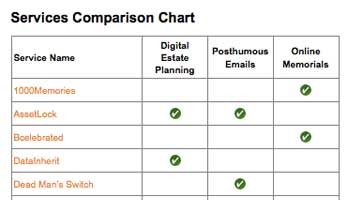
The Digital Beyond has added a comparison chart to their Digital Death Services List. Visitors to the site can now scan down our handy list and see at a glance if a service offers:

  • Digital Estate Planning
  • Posthumous Emails
  • Online Memorials

“We wanted to provide a chart to help make finding a service easier.” said Evan Carroll. “The list of companies offering services in this space is growing at such a rapid pace. We simply needed something to tell them apart. Oh, and there’s more to come. Stay tuned.”

Comments (0)

Learn more about our new book, Your Digital Afterlife. Find us at SXSW Interactive.